Out of Plane
A 9 × 6 ft parametric Voronoi installation. The most random pattern, made through perfect planning.
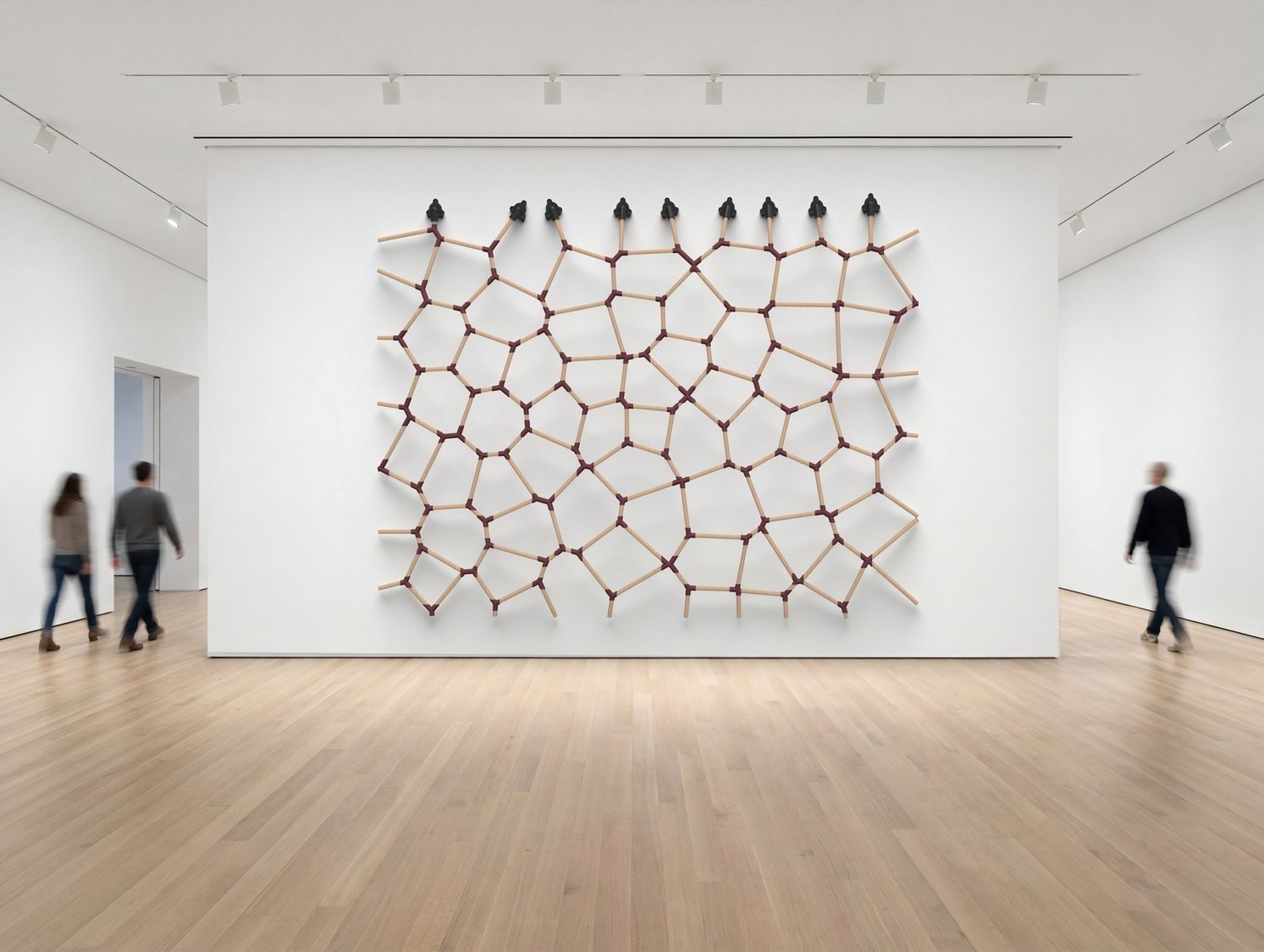
Out of Plane is the capstone project for my DFD (Digital Fabrication and Design) certificate at UWM (University of Wisconsin–Milwaukee). A 9 × 6 ft wall-mounted installation built from a parametric Voronoi field, generated in Grasshopper and fabricated through 3D-printed PLA and PLA-CF joints connected by 3/4-inch wood dowels.
The project sits between three things at once: a study in computational geometry, a fabrication exercise, and a finished sculptural object. The title, Out of Plane, points at what the work is doing: a flat, mathematically generated network pulled off the wall into physical space, every node and edge made by hand.
The brief I set for myself was simple but uncomfortable: take on the most complex challenge the program had to offer, and see if I could land it.
The thesis behind the form was a single sentence: the most random pattern, made through perfect planning. A Voronoi tessellation looks chaotic at a glance: no two cells the same, no obvious grid. But every cell, every edge, every joint has to be parametrically defined, individually labeled, and physically fabricated to assemble at full scale. The randomness on the surface is held together by complete control underneath.
The hard part was never the geometry. It was managing the gap between digital and physical at scale.
How it was made
Generating the field in Grasshopper
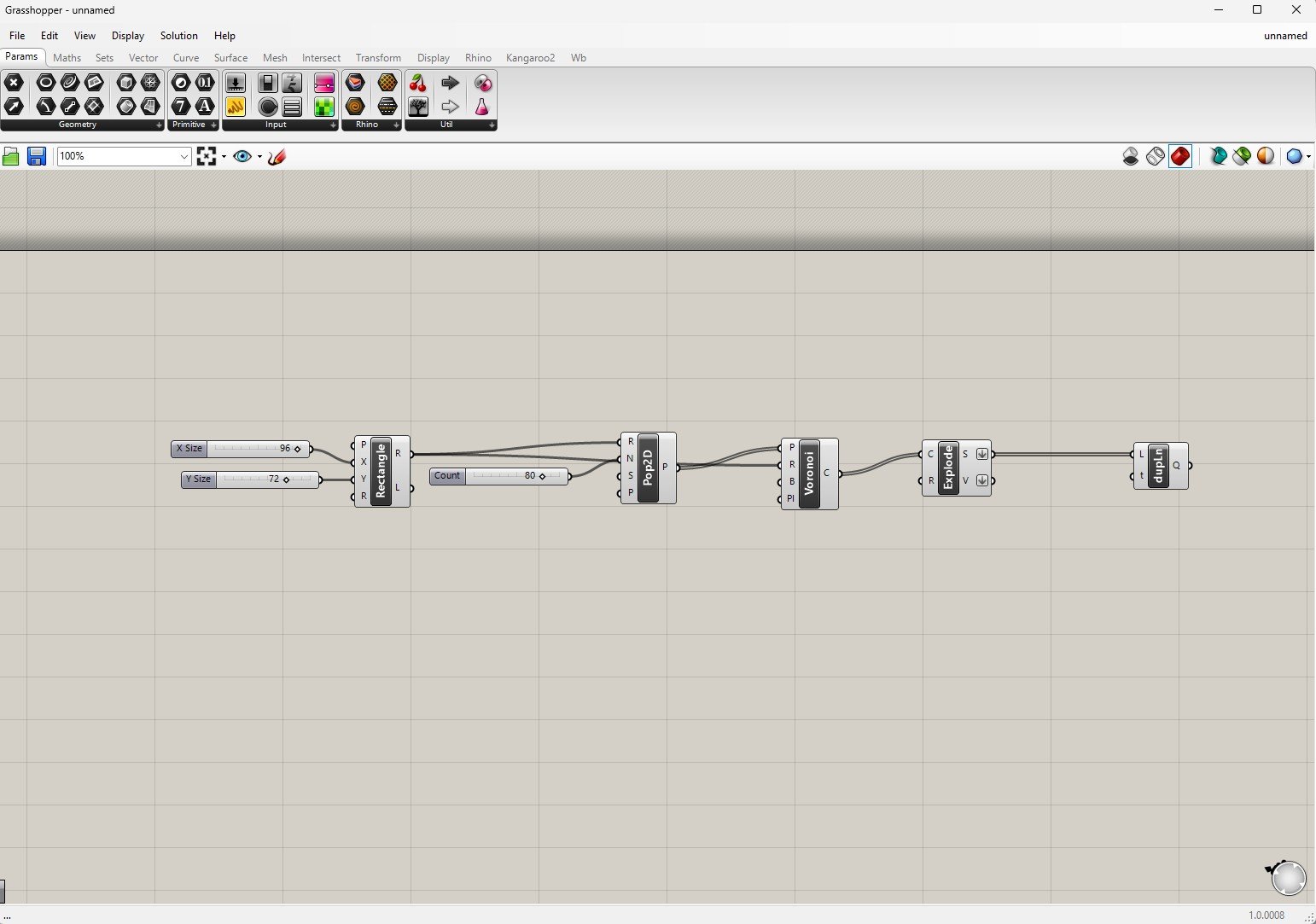
The Voronoi was built in Grasshopper from a small but deliberate definition: a 9 × 6 ft Rectangle as the bounding frame, Pop2D to scatter seed points across it, Voronoi to tessellate the cells, then Explode and dupln to break the cells into individual edges and joint locations. Two parameters drove the entire system: cell density (Count in Pop2D) and edge thickness. The whole field could be re-generated with two sliders, which meant I could test density and weight against each other dozens of times before committing to a single seed.
Labeling every cell
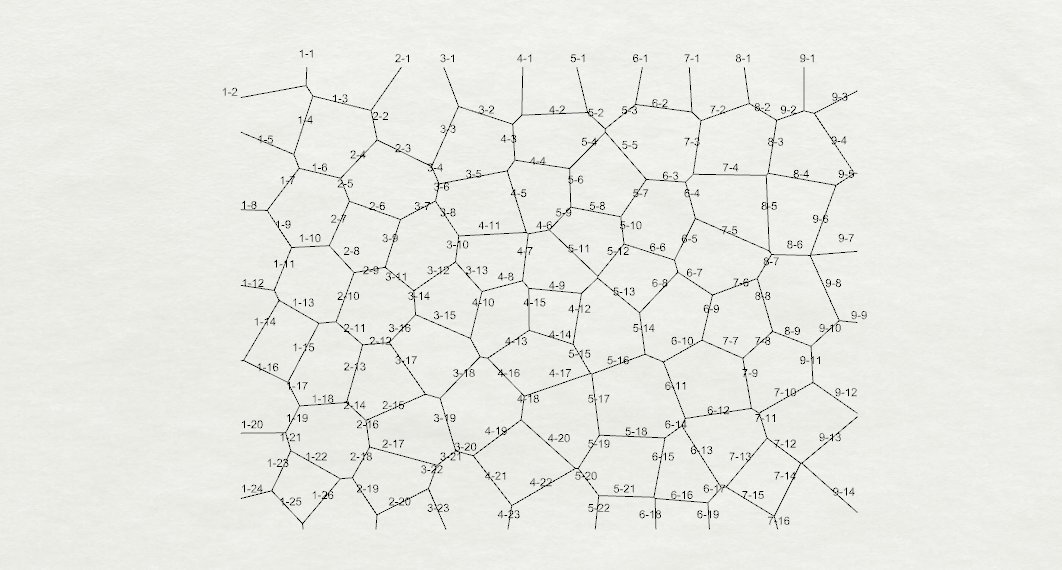
Once the geometry was locked, every cell and every edge had to be uniquely numbered before fabrication could begin. Without this step the wall would be impossible to assemble: there are no two identical pieces in a Voronoi. Each cell received a coordinate ID (1-1, 1-2, 2-1, etc.) so that each rod, each joint, and each connection point could be tracked from digital file to printer to finishing station to wall.
Printing the joints · PLA and PLA-CF
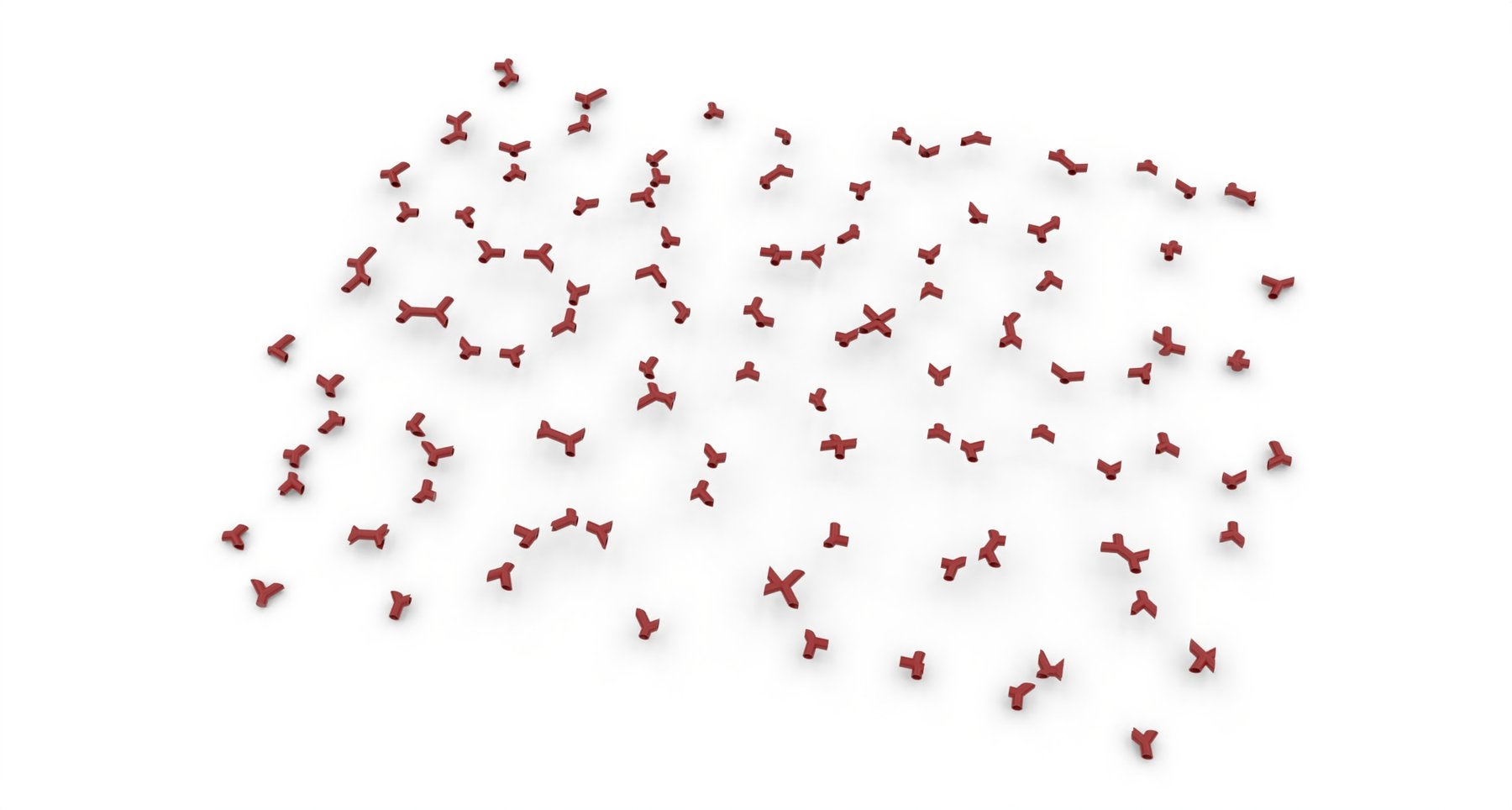
Every node where edges meet became a custom 3D-printed joint. The body of the field used standard PLA, while the top row of hanger parts (the ones taking the entire weight of the structure) were printed in PLA-CF (carbon-fiber-reinforced PLA) for stiffness. Because every joint sits at a different angle in the field, no two joints are the same. Each one was modeled, oriented, and printed as its own part. The edges between joints are 3/4-inch wood dowels, cut to the exact length each Voronoi edge required.
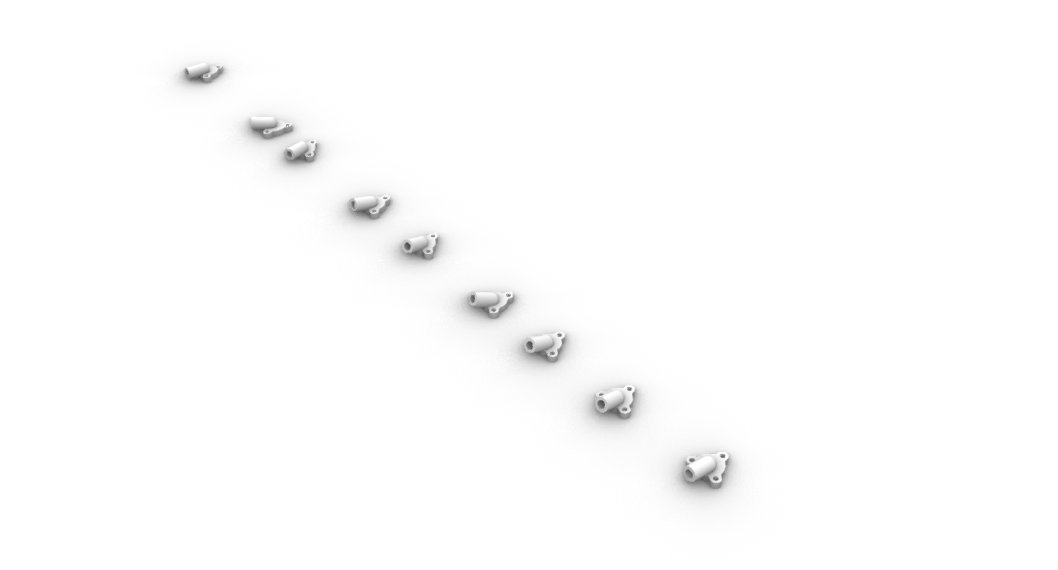
The hardest part · keeping the pieces straight
The geometry was the easy half. The hard half was the workshop. Every printed joint had to be filed, sanded, primed, and spray-painted before assembly. With dozens of unique parts, each only distinguishable by tiny labels, the real challenge was logistical: building a system to keep parts from getting mixed up during finishing, and to assemble them efficiently on the wall in the right order. This was the work that didn't show up in any rendering. But it was the work that decided whether the project finished on time.
Installation
The final piece was mounted on a gallery wall, suspended from a row of black anchor brackets at the top edge, letting the structure read as if it's pulled out of the surface rather than attached to it.
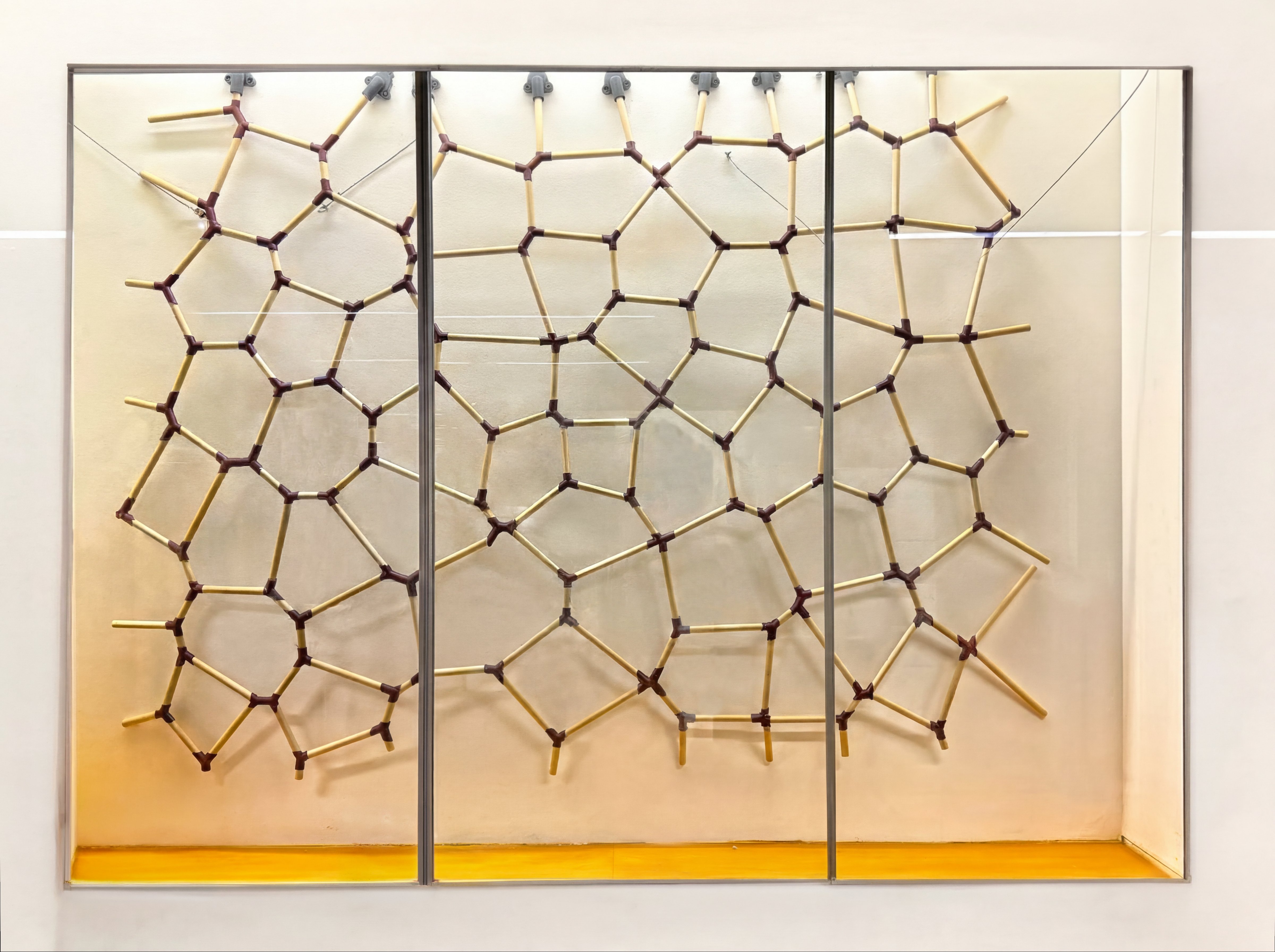
Out of Plane was completed and exhibited as my DFD capstone. It was my first installation work, and it landed the way it was planned. The most random pattern, made through perfect planning, end to end.